-

-
 October 16, 2026
60Hz High Pressure Washer Suppliers in UAE
-

-

-
 September 25, 2026
60Hz Commercial Clothes Dryer Supplier in UAE
Marine Air Conditioner in Dubai: The Complete Buying Guide for Yachts, Ships & Offshore Vessels
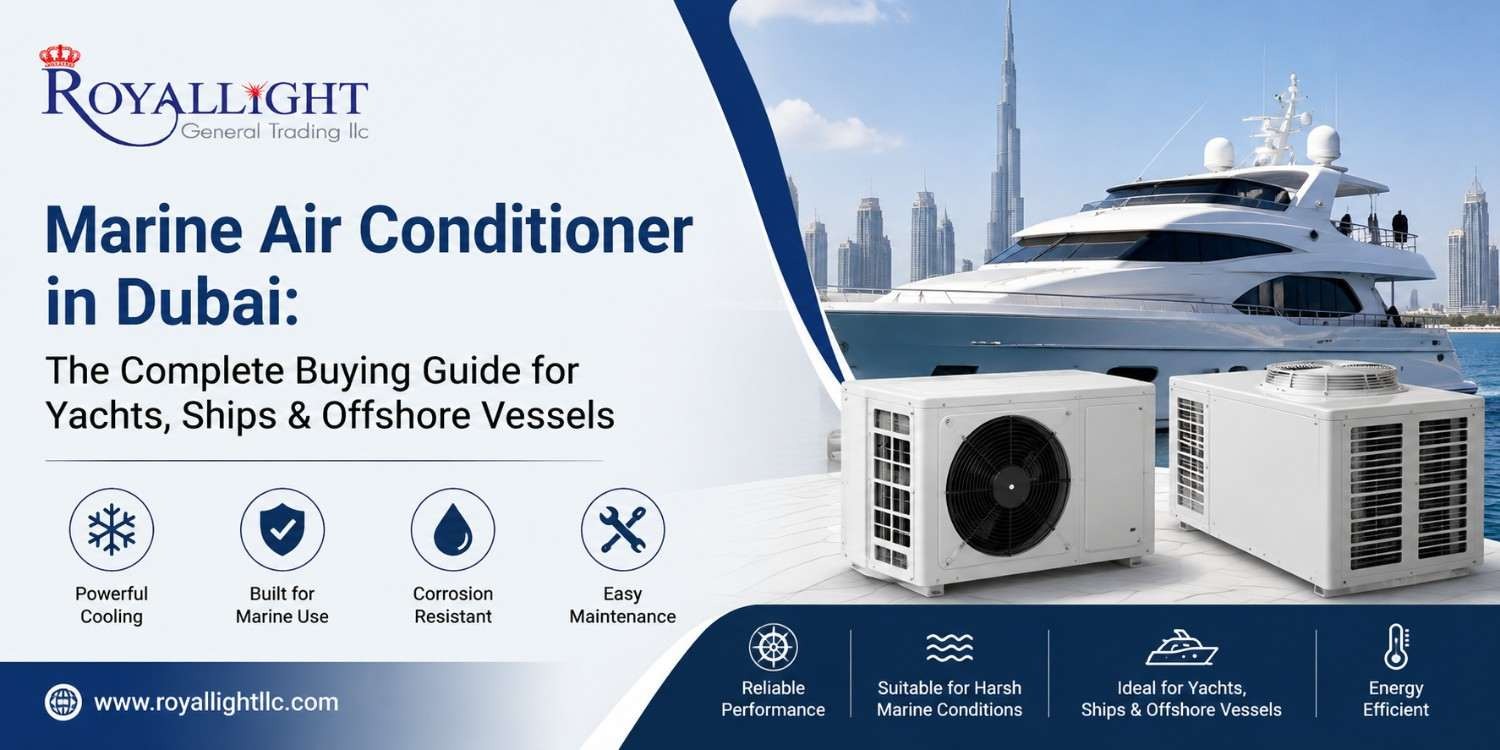
Dubai’s heat doesn’t stop at the shoreline. On board a yacht, cargo vessel or offshore platform in the Arabian Gulf, cabin and equipment-room temperatures can escalate even faster than they do on the ground, so it is why a marine air conditioner is not just a comfort upgrade but operational equipment. But crew, electronics, refrigerated cargo and guest experience all depend on cooling systems designed specifically for the marine environment and not to be made at home.
At Royal Light LLC, we supply 60Hz marine air conditioners in Dubai and across the UAE to yachts, cruise vessels, cargo ships, and offshore facilities. This guide covers what a marine air conditioner actually is, why it’s different from a standard AC unit, what to look for before buying, and how to choose the right system for your vessel.
What Is a Marine Air Conditioner?
A marine air conditioner is a cooling system that operates and has been designed for a marine environment which can be used in saltwater, high temperature and humidity and high vibration conditions (and therefore for a marine AC unit that is not a regular household or commercial AC unit)
Marine air conditioners are corrosion-resistant, have seawater or raw water cooling loops and compressors that will be able to work at sea for continuous work.
Marine air conditioners must be able to operate with the electrical supply of the ship’s electrical supply (or at least the electrical power of most UAE buildings’ electrical supply which is usually 60Hz, unlike the 50Hz standard which is the case in a sea-based structure (e.g. from the UAE).
When the frequency equipment is not working onboard, the system will get overheated and compressor life will be compromised. This is why vessel owners want 60Hz air conditioners instead of the standard retail system.
Why Marine Air Conditioning Matters in the UAE
The Arabian Gulf is one of the most demanding conditions any cooling system will face:
- Sustained ambient temperatures above 45 °C in summer.
- Heavy humidity and salt-laden air that can accelerate corrosion.
- Constant vibration and motion at sea.
- There is limited access to repair facilities offshore.
- Great 24/7 operation cycles with very little downtime.
A cooling system that is not designed to operate at these conditions is poor performance-wise, expensive to run, and will put crew comfort and electronics, and safety systems at risk if they don’t work.
Mistake #1: Choosing a Residential AC Instead of a Marine-Rated Unit
Split or window units are not designed to handle saltwater exposure or constant vibration.
On board this usually means:
- Corroded coils and housings in months.
- Frequent refrigerant leaks.
- Over time decreased cooling capacity.
- No warranty as most residential units are not marine-rated.
Marine-rated systems use coated coils, sealed electrical components, and vibration-resistant mounting to avoid this.
Mistake #2: Ignoring Voltage and Frequency Compatibility
Vessels usually run 110V, 220V or 440V systems at 50Hz or 60Hz depending on the ship and electrical design.
A mismatched unit can cause:
- Compressor overheating, reduced lifespan.
- Unbalanced temperature control.
- Electrical faults.
Check your vessel’s voltage and frequency before purchasing.
A good manufacturer of marine air conditioners in Dubai will ask this question before recommending a unit.
Mistake #3: Undersizing or Oversizing the Unit
Cabin size, insulation, window area and heat-generating equipment all affect the correct BTU capacity.
An undersized unit runs continuously, does not reach the temperature and wears out faster.
An oversized unit that turns on and off way too often wastes energy and humidity control issues are present.
Correcting the BTU calculation and doing it in the first place avoids costly replacements later.
Mistake #4: Overlooking Energy Efficiency
Air conditioning is one of the biggest continuous power draws on a vessel.
Energy-efficient marine units reduce:
- Fuel or generator load.
- Heat from the engine and equipment rooms.
- Long-term operating costs.
Looking for efficient compressors and good insulation and a reliable thermostatic control.
Mistake #5: Poor Installation and Ventilation Planning
Even a good marine air conditioner fails if installed improperly.
To prevent:
- Blocking airflow around condenser units.
- Installing it near the engine or around other heat sources.
- Make the right seawater intake and drainage plan.
Proper installation will positively affect cooling performance and equipment life.
Mistake #6: Skipping Regular Maintenance
And since saltwater systems are meant to be serviced more frequently than land-based AC units, not doing so in this way leads to:
- Lower cooling efficiency.
- Raw-water pump and strainer blockages.
- Early compressor failure.
Keeping the systems running during the summer months with a good provider is a good way to keep it going.
Types of Marine Air Conditioners We Supply
Split AC units
Quiet, efficient cooling for cabins and crew quarters with the compressor mounted separately from the indoor unit.
Portable AC units
Compact cooling for smaller and temporary setups without ductwork.
Floor-standing AC units
Higher capacity cooling for larger cabins, lounges or common areas.
Spot AC units
Targeted cooling for equipment rooms, control stations or specific work areas.
Industries That Rely on Marine Air Conditioners
Yachts & Superyachts
Guest comfort and onboard electronics rely on quiet cooling.
Cargo & Cruise Ships
Crew quarters, galleys and control rooms need reliable AC that will operate continuously at sea.
Offshore Platforms
Extreme heat and limited access to maintenance are critical for cooling systems with low failure rates.
Commercial Vessels & Fishing Fleets
Reliable cooling protects crew welfare and supports onboard equipment during long sea voyages.
Features to Look for in a Marine Air Conditioner
- 60Hz (or dual 50/60Hz) compatibility matched to your vessel.
- Corrosion-resistant coils and housing.
- Sealed, marine-rated electrical components.
- Reliable seawater cooling and drainage system.
- Energy-efficient compressor.
- Manufacturer warranty and after-sales support.
Why Choose Royal Light LLC for Marine Air Conditioners in Dubai
Royal Light General Trading LLC has been providing marine and commercial appliances in the UAE and outside the country since 2003.
Marine air conditioning customers choose us because we offer:
- Genuine 60Hz marine-rated AC units.
- Split, portable, floor-standing, and spot AC options.
- Trusted brands including Matrix.
- Guidance on correct voltage, frequency, and BTU sizing.
- Worldwide shipping from Dubai.
- Ongoing product and after-sales support.
Need a marine air conditioner for your vessel? Contact Royal Light LLC or call +971 4 297 3341 for a quote.
Frequently Asked Questions
Find answers to common questions.
A marine air conditioner is a cooling system built specifically for boats, ships, and offshore vessels, using corrosion-resistant components and a seawater cooling loop to withstand saltwater exposure, humidity, and constant vibration at sea.
Many vessels, especially those built to US or international marine standards, use a 60Hz electrical system. Installing a 60Hz-rated marine air conditioner ensures the compressor runs at the correct speed, preventing overheating and premature failure.
It’s not recommended. Household units lack corrosion protection and marine-rated components, and typically fail quickly when exposed to saltwater air and constant vibration.
Sizing depends on cabin volume, insulation quality, window area, and heat-generating equipment nearby. A marine air conditioner company can calculate the correct BTU capacity based on your vessel’s specifications.
Yes, Royal Light LLC supplies and ships marine air conditioners and other marine appliances from Dubai to the USA and other locations worldwide.
Royal Light LLC provides marine air conditioners in 110V, 220V & more in different vessel electrical systems at 50/60Hz.